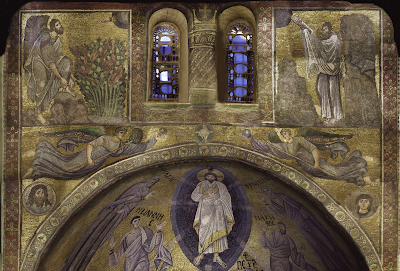
Nikola Benin Mid sixth century apse mosaic, Saint Catherine’s Monastery, Egypt – These beautiful Late Antique mosaics have a special focus on the history of holy places near the Monastery, whose official name is the Sacred Monastery of the God-Trodden Mount Sinai. The wall mosaics above the apse show two scenes from the life of Moses, associated with sacred sites venerated at this location. On the top left, a young Moses is shown before the burning bush, removing the sandals from his feet. His gaze is fixed on the hand of God, which is appearing to him --- On the top right, a slightly older looking Moses is receiving the law from the hand of God --- Directly above the apse are two angels, each is holding an orb and a rod topped with a cross, symbols of authority --- On the bottom left is a medallion image of Saint John the Baptist and on the bottom right is a medallion image of the Virgin Mary --- Within the apse mosaic itself, an old looking Moses (identified by the inscription ...


Коментари
Публикуване на коментар